Fun Questions For Couples: The Honest Decision Guide for Your Next Move
The hardest part is not always understanding the situation. It is choosing what to do when hope and evidence point in different directions. That is why this guide approaches fun questions for couples as a real-life decision, not a performance. You will get a decision framework that protects both your heart and your future self. The goal is not to drain the topic of mystery or hope. It is to keep hope connected to consent, evidence, emotional safety, and actions you can actually choose. You can share a home, a calendar, and a hundred daily updates while barely touching each other’s inner world. Curiosity brings the person back into focus.


The Four-Lens Decision Test
1. Reality
What has happened more than once? For fun questions for couples, repeated behavior outweighs one moment.
2. Reciprocity
Is effort mutual, or are you doing all the initiating, waiting, or repairing? Mutuality requires participation.
3. Risk
What could this choice cost emotionally, financially, socially, or physically? Lower risk before commitment.
4. Reversibility
Prefer a small step you can review. A pause, one conversation, or a seven-day experiment gives you information without handing over your future.
Green, Yellow, or Red?
- Green: You feel steady, consent is respected, and reality supports a small next step.
- Yellow: Evidence is mixed, urgency is high, or you need more information. Slow down.
- Red: There is coercion, abuse, financial pressure, a boundary violation, or severe distress. Stop and seek appropriate support.
The best fun questions for couples decision is one your future self can live with.
Evidence to Put on the Table
These signs do not automatically prove a conclusion. They show where fun questions for couples needs a slower, more honest look.
Most conversations are about tasks. Check the evidence and one alternative explanation.
Date night defaults to screens. Check the evidence and one alternative explanation.
You assume you already know every answer. Check the evidence and one alternative explanation.
Serious talks feel too loaded to begin directly. Check the evidence and one alternative explanation.
You keep searching for a new answer before testing the last useful insight.. Check the evidence and one alternative explanation.
Your body feels tense, rushed, or unable to tolerate a pause.. Check the evidence and one alternative explanation.
You are collecting signs while avoiding a direct boundary or conversation.. Check the evidence and one alternative explanation.
The promise sounds certain, but the evidence remains vague.. Check the evidence and one alternative explanation.
You feel less like yourself the longer you stay inside the question.. Check the evidence and one alternative explanation.
What Your Choice Is Really About
Open-ended questions invite elaboration and responsive listening. The benefit is not collecting facts; it is showing that each partner’s current thoughts still matter. In practice, fun questions for couples becomes useful when it helps you notice a pattern and respond differently. It becomes less useful when it asks you to ignore facts, surrender your judgment, or treat another person’s autonomy as an obstacle.
A good rule is to separate three layers: what happened, what you fear it means, and what you can do next. That small separation reduces urgency. It also makes fun questions for couples easier to use as a reflective tool rather than a source of endless reassurance.
Make the Decision in Five Moves
Use this sequence once before adding more techniques. With fun questions for couples, repetition of a grounded process is more informative than constant switching.
Step 1: Create low-pressure rules
Each person may pass, ask a follow-up, or pause a sensitive topic. Keep the step small enough to repeat when you are tired or emotional. Afterward, write down what changed in your behavior—not only how hopeful you felt.
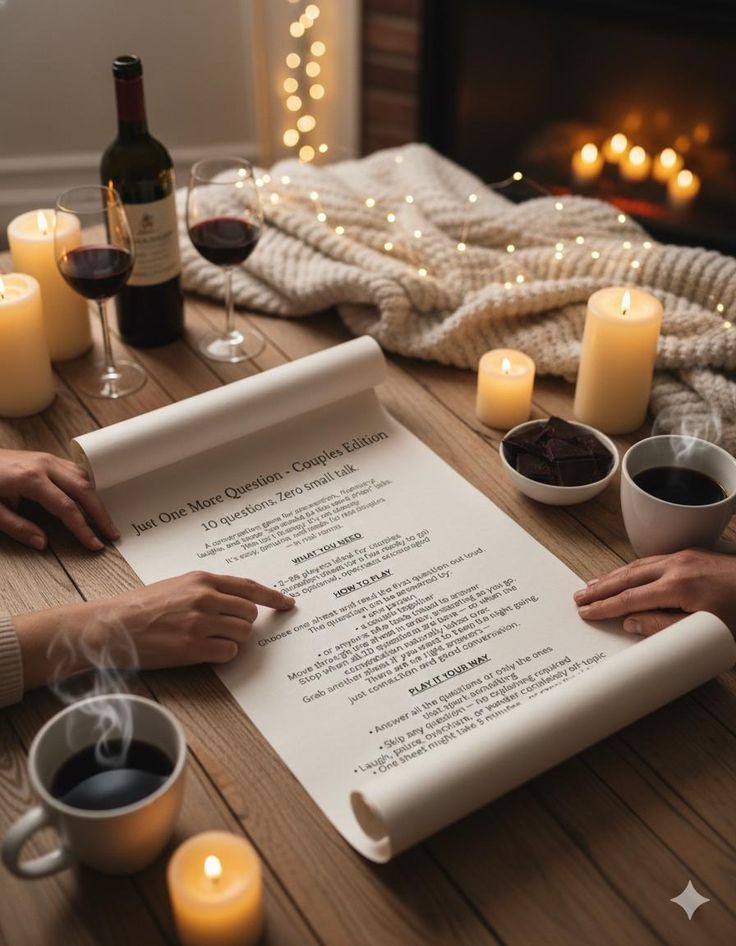
Step 2: Start playful
Use imagination, memories, and harmless preferences to build warmth. Keep the step small enough to repeat when you are tired or emotional. Afterward, write down what changed in your behavior—not only how hopeful you felt.
Step 3: Move toward meaning
Ask about values, growth, and the kind of support that feels loving. Keep the step small enough to repeat when you are tired or emotional. Afterward, write down what changed in your behavior—not only how hopeful you felt.
Step 4: Reflect before replying
Summarize what you heard instead of turning every answer into your own story. Keep the step small enough to repeat when you are tired or emotional. Afterward, write down what changed in your behavior—not only how hopeful you felt.
Step 5: End with one appreciation
Name something newly understood or deeply valued. Keep the step small enough to repeat when you are tired or emotional. Afterward, write down what changed in your behavior—not only how hopeful you felt.
The Safety Filter to Use Every Time
Before acting on fun questions for couples, run the idea through four filters:
- Consent: Does this respect a clear no, a block, privacy, and the other person’s freedom?
- Evidence: Am I responding to repeated behavior or to a prediction I desperately want to be true?
- Cost: Is this asking for money, secrecy, escalating contact, lost sleep, or isolation from people I trust?
- Agency: Do I leave with a choice I can make, or with pressure to depend on someone else for the next answer?
Stop if fear is being used to rush a payment or decision. Pause if the practice worsens sleep, compulsive checking, or conflict. For abuse, self-harm risk, severe distress, or a mental health crisis, choose qualified local support rather than relying on fun questions for couples alone.
Frequently Asked Questions About Fun Questions For Couples
What are good fun questions for couples?
The best prompts are open-ended, specific, and safe enough to answer honestly.
How many questions should we ask?
Five thoughtful questions can create more connection than rushing through fifty.
What if an answer causes conflict?
Slow down, clarify what was meant, and schedule a separate conversation if the topic needs more care.
The Bottom Line
fun questions for couples should help you become more honest, more grounded, and more able to choose—not more frightened or dependent. Keep what supports clarity. Release what asks you to abandon consent, evidence, or yourself.